Ceramic Dinnerware Sets
Ready-Made Combinations of Hand-Built Plates and Bowls
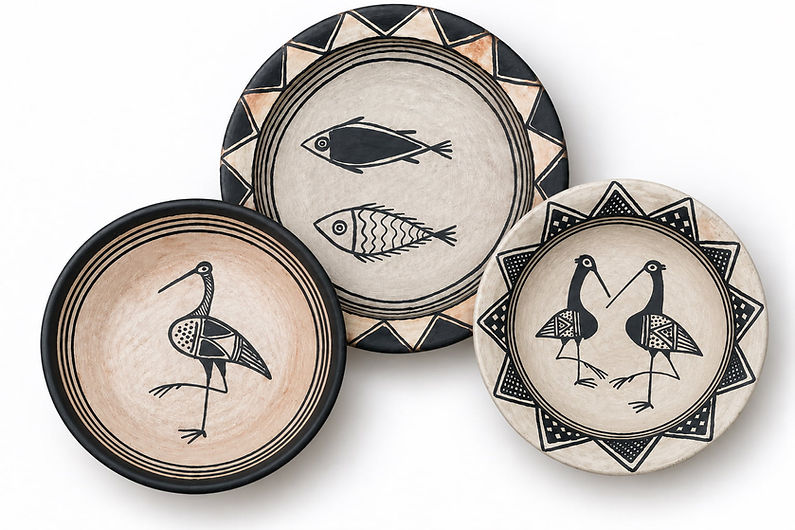
These ceramic dinnerware sets bring together plates and bowls made by Chmissa in Sejnane, northern Tunisia. Each predefined combination is organised around a particular table situation: one individual setting, shared serving, an everyday table for two, or individual and shared forms for four.
These are not conventional factory-standard dinnerware services composed of mechanically identical pieces. They are combinations of Chmissa’s hand-built forms, selected according to the different roles plates and bowls can perform around a table.
Each set has fixed contents. Compare the four arrangements below, or build your own ceramic set if you need different quantities.
The Four Ready-Made Sets

Essential Place Setting: One Plate and One Bowl
The Essential Place Setting is the smallest ready-made combination in the collection.
The set contains
-
1 Zerka Plate
-
1 Zephyr Bowl
-
2 pieces in total
The two forms provide distinct options within one individual setting.
The Zerka Plate offers a broad central surface with rising walls. It can hold an individual meal while providing more containment than a flat plate.
The Zephyr Bowl is deeper. Its height and inward volume suit meals that mix, carry sauce, or benefit from a more contained form.
Together, they create one plate-and-bowl pairing without introducing pieces intended primarily for shared serving.

Shared Table Set: Forms for the Centre of the Table
The Shared Table Set is composed entirely of shared forms.
The set contains
-
1 Hout Plate
-
2 Storka Bowls
-
3 pieces in total
The Hout Plate extends the rising-wall plate form to a larger scale. Its broad central surface can hold food intended to be reached from different places around the table.
The two Storka Bowls provide lower and more open forms. They can hold separate dishes or distribute the same kind of food across different parts of a table.
This set is useful when individual plates and bowls are already available but additional serving pieces are needed.
It is not assigned to a fixed number of diners. Its suitability depends on the food being served, the table arrangement, and the individual tableware accompanying it.

Daily Table Set: Two Individual Settings and One Shared Bowl
The Daily Table Set combines two individual place settings with one form positioned for shared use.
The set contains
-
2 Zerka Plates
-
2 Zephyr Bowls
-
1 Storka Bowl
-
5 pieces in total
Each person receives one Zerka Plate and one Zephyr Bowl. The pairing provides both a broad rising-wall plate and a deeper bowl.
The Storka Bowl introduces a shared layer between the two settings. Its lower walls and open structure keep its contents visible and accessible from more than one position around the table.
This arrangement is the clearest ready-made starting point for two people who want both individual forms and one bowl for a shared dish.

Hosting Table Set: Individual and Shared Forms for Four
The Hosting Table Set is the broadest predefined combination in the collection.
The set contains
-
4 Zerka Plates
-
4 Zephyr Bowls
-
2 Storka Bowls
-
1 Hout Plate
-
11 pieces in total
The four Zerka Plates and four Zephyr Bowls form four individual plate-and-bowl pairings.
The two Storka Bowls provide open forms for shared dishes, while the larger Hout Plate introduces a broad central serving surface.
This structure makes it possible to place individual and shared forms on the table together. It provides a defined arrangement for four without suggesting that every meal must use every piece at the same time.
The set contains the exact pieces listed above. It is not a conventional dinner service containing side plates, cups, or mechanically matching pieces.
Which Set Fits Your Table?
Starting with one individual setting?
Choose the Essential Place Setting. It combines one Zerka Plate with one deeper Zephyr Bowl.
Adding serving pieces to tableware you already own?
Choose the Shared Table Set. It contains one Hout Plate and two Storka Bowls for food placed at the centre of the table.
Preparing an everyday table for two?
Choose the Daily Table Set. It provides two individual plate-and-bowl pairings accompanied by one shared Storka Bowl.
Combining individual and shared forms for four?
Choose the Hosting Table Set. It contains four individual pairings, two shared bowls, and one larger shared plate.
Need different quantities?
If the predefined combinations do not correspond to your household, existing tableware, or way of serving food, [build your own ceramic set].
You can also [compare ceramic bowl sizes] and [compare ceramic plate sizes] before choosing individual products.
A Set Does Not Mean Identical Pieces


These sets are coordinated, but their pieces are not mechanically identical.
Every object is built and marked by hand. Differences can therefore appear in:
-
diameter and overall outline;
-
wall height and openness;
-
depth and profile;
-
surface texture;
-
cream, earth, grey, and black tonal distribution;
-
line placement;
-
geometric arrangements;
-
execution of bird and fish motifs.
The four product types remain recognisable, and every set retains its stated contents. Variation appears within those forms rather than replacing one product with another.
This distinction matters when several examples of the same product appear together. Four Zerka Plates, for example, share one product identity without becoming exact copies of one another.
Handmade variation does not include cracks, sharp breaks, instability, delivery damage, or an object materially different from its description. Read Handmade Ceramic Variation for a fuller explanation of what may reasonably differ between pieces.
Made by Chmissa in Sejnane


Every piece included in these ceramic dinnerware sets is made by Chmissa in Sejnane.
Her work begins before a plate or bowl acquires its final form. She gathers clay from the surrounding environment and participates in the principal stages of preparing it for use. The material is broken down, cleaned, soaked, kneaded, and brought to a condition suitable for shaping.
Chmissa builds each object directly by hand without using a potter’s wheel. She must judge moisture, pressure, thickness, support, and balance as the walls develop.
She also works through the marking, drying, and firing stages. Her daughter may assist when a task becomes physically demanding, while family life remains close to the places around the home where Chmissa works.
Chmissa learned pottery by watching her mother when she was young. She did not enter the practice through a separate formal system; she found herself participating in the work that surrounded her.
Her visual language also emerges from familiarity. Birds, fish, lines, triangles, checks, borders, and repeated geometric arrangements appear across her pottery. She connects parts of this vocabulary to animals and landscapes around Sejnane and to forms once seen in Amazigh tattoo traditions. These references should not be treated as a fixed code in which every mark carries one predetermined meaning.
Meet Chmissa, learn about Sejnane pottery, or follow the Sejnane pottery-making process.
Caring for Your Ceramic Set
Wash each piece by hand and dry it thoroughly.
Avoid prolonged soaking and sudden changes in temperature. Do not place the ceramics in a dishwasher, microwave, oven, freezer, on a stovetop, or over direct flame.
Store pieces securely and avoid unstable stacking. When placing one object inside another, use suitable protection between their surfaces and make sure the stack cannot shift or place excessive pressure on the lower pieces.
Stop using a piece if it becomes cracked, sharply damaged, or unstable. Contact Customer Care if an object arrives damaged or if you need guidance about its condition.
Read the complete Ceramic Care Guide before regular use.
Choose a Ready-Made Set or Build Your Own
A ready-made set is useful when its exact contents already correspond to your table.
Choose one of the predefined sets when:
-
you want one individual plate-and-bowl pairing;
-
you need a dedicated group of shared serving forms;
-
you want individual settings for two with one shared bowl;
-
you need individual and shared forms for four;
-
you are starting without overlapping pieces.
A custom arrangement may work better when:
-
your household requires different quantities;
-
you already own some of the products;
-
you want additional shared forms;
-
you use plates more frequently than bowls, or bowls more frequently than plates;
-
your everyday table and hosting table require different combinations.
The Build a Ceramic Set guide helps you calculate individual settings, shared forms, and useful quantities without forcing your table into a predefined package.
Frequently Asked Questions
What is included in each ceramic dinnerware set?
The Essential Place Setting contains one Zerka Plate and one Zephyr Bowl. The Shared Table Set contains one Hout Plate and two Storka Bowls. The Daily Table Set contains two Zerka Plates, two Zephyr Bowls, and one Storka Bowl. The Hosting Table Set contains four Zerka Plates, four Zephyr Bowls, two Storka Bowls, and one Hout Plate.
Which set is suitable for one person?
The Essential Place Setting is the predefined individual combination. It contains one Zerka Plate and one Zephyr Bowl.
Which ceramic set is designed for two people?
The Daily Table Set provides two individual plate-and-bowl pairings with one Storka Bowl for shared use.
Which set combines individual and shared tableware for four?
The Hosting Table Set combines four Zerka Plates and four Zephyr Bowls with two Storka Bowls and one Hout Plate.
Is the Shared Table Set intended for a fixed number of people?
No fixed diner count is assigned to it. The Shared Table Set is a group of serving forms intended to accompany individual tableware. Its suitability depends on the dishes being served and the wider table arrangement.
Will every piece in a set look identical?
No. The pieces share recognisable forms and a related visual language, but differences in outline, surface, colour, proportions, and markings can appear because Chmissa builds and marks them by hand.
Can I choose different quantities?
Yes. If none of the four ready-made sets corresponds to your needs, use the Build a Ceramic Set guide and select the individual products in different quantities.
How should I care for the ceramics?
Wash them by hand, dry them thoroughly, and avoid prolonged soaking and sudden temperature changes. Do not use them in a dishwasher, microwave, oven, freezer, on a stovetop, or over direct flame. Consult the Ceramic Care Guide for complete instructions.
Who makes the dinnerware sets?
Chmissa makes every Zerka Plate, Hout Plate, Zephyr Bowl, and Storka Bowl included in these sets at her home in Sejnane.
Shop the Sets
Compare the current prices, availability, images, and complete product details for all four ready-made combinations. If none of these combinations fits your table, build your own ceramic set from the four individual forms.


