Sejnane Pottery
Updated: Aug 28

Sejnane pottery is a women-led earthenware practice from northern Tunisia.
Using clay gathered from the surrounding landscape, potters prepare and shape vessels, animals, dolls, and human figures directly by hand. A potter’s wheel is not required. Surfaces are developed through clay, earth-based coatings, plant-derived materials, markings, polishing, and firing methods that can differ between makers.
The knowledge involved extends beyond the finished objects. It includes recognising suitable clay, preparing it, controlling moisture, building stable forms, treating their surfaces, and judging the conditions of drying and fire.
In 2018, the pottery skills of the women of Sejnane were inscribed on UNESCO’s Representative List of the Intangible Cultural Heritage of Humanity.
Quick Guide
What Is Sejnane Pottery?


Sejnane pottery is a hand-built earthenware practice associated with Sejnane and its surrounding communities in the Governorate of Bizerte.
Its defining characteristics do not belong to one decorative pattern or product shape. They emerge from a wider working system: locally gathered clay, preparation by hand, building without a wheel, surface treatment using available materials, drying, firing, and knowledge carried principally by women.
The practice supports a wide range of objects. Some respond to domestic needs, including bowls, dishes, pots, and containers used for preparing, serving, carrying, or storing food and water. Others take the form of animals, dolls, human figures, and decorative or sculptural works.
These categories are connected. The knowledge required to judge clay, control moisture, build a stable wall, model a body, or prepare a surface can move across both vessels and figures.
There is no single appearance shared by every Sejnane object. Forms, colours, proportions, markings, and surface treatments vary between makers and pieces. This variation is not separate from the tradition. It is one of the ways individual decisions remain visible within a shared body of knowledge.
UNESCO’s 2018 inscription concerns these skills and their transmission. It does not certify individual objects or define one approved Sejnane style.
A Practice Rooted in Northern Tunisia


Sejnane lies in the hills of northern Tunisia, within the Governorate of Bizerte and not far from the Mediterranean coast.
The surrounding terrain is part of the pottery system. Clay is generally gathered locally, including from the beds of seasonal wadis. Earth, plants, water, fuel, and the spaces available around the home can all participate in the transformation of raw material into a finished object.
Production does not depend on a standardised studio. Pottery may be prepared and shaped in courtyards, domestic spaces, outdoor shelters, or other working environments integrated into daily life.
This does not make the process accidental. It means the working system has developed around a different organisation of space.
A courtyard can provide room to prepare clay, shape objects, place pieces on the ground, and allow them to dry. Finished and unfinished work may gather around the home. Tools and materials can remain close to the activities through which they are used.
These environments are not identical for every potter. Each maker works within the space, materials, resources, and conditions available to her. The relationship between landscape and practice is therefore local without being uniform.
The clay begins in the environment, but it does not arrive ready to use. Before an object can take shape, the material must be recognised, gathered, processed, and brought into a workable condition.
Knowledge Carried Between Women


The pottery skills of Sejnane are associated particularly with women.
Knowledge has often been carried through families and communities, where younger generations learn by remaining close to the work of mothers, grandmothers, relatives, and other experienced potters. UNESCO’s documentation describes traditional and informal education alongside organised training opportunities for young women who wish to develop the practice.
Learning is sometimes summarised through the phrase “hands remember.” But hands do not remember automatically.
They learn through attention, repetition, demonstration, correction, and time.
A learner has to recognise when clay contains the right amount of moisture. She has to understand how much pressure a wall can accept, how two sections can be joined, when a surface is stable enough to treat, and how long an object must dry before it faces fire.
Much of this knowledge is difficult to separate into fixed instructions. The material changes with weather, source, preparation, thickness, and form. A decision that works for one object may need adjustment for another.
Transmission therefore involves more than copying a finished shape. It includes learning how to respond when the material behaves differently.
Pottery also exists within wider family and economic relationships. UNESCO notes that women carry out the recognised production stages while men may participate in selling the work. Contemporary roles and circumstances can vary, but women remain central to the knowledge system formally recognised through the inscription.
This knowledge is neither anonymous nor owned by one person. It is shared across a community while being practised through individual lives.
From Local Clay to Hand-Built Form


The making process begins before an object becomes visible.
Clay gathered from the landscape may contain stones, roots, and other unwanted matter. It is generally cut or broken down, crushed, purified, soaked in water, and kneaded before shaping begins.
Some documented potters add material obtained from crushed pottery fragments or brick. This acts as temper, changing how the clay behaves during forming, drying, and firing. The precise preparation can differ between makers, material sources, and periods.
Once workable, the clay is shaped directly by hand.
A potter’s wheel creates form through continuous rotation. In Sejnane, the maker develops the object through pressure, support, joining, modelling, and gradual adjustment. A base may be established before the walls rise. Additional clay can be added where volume or structure is needed. A figure may develop through the modelling of the head, body, limbs, and facial features.
The absence of a wheel is not the absence of technique.
The maker must manage thickness, balance, moisture, and structural pressure throughout the build. Clay that is too wet can collapse. Clay that becomes too dry may resist joining or crack under pressure. Each stage depends on judging what the material can accept at that moment.
Direct building also allows the maker’s decisions to remain visible. Subtle asymmetries, changes in proportion, modelling traces, and variations in the surface can record the sequence through which the object emerged.
The process can be explored in greater depth through The Village Where Pottery Is Still Made Without a Wheel, which follows clay from preparation through shaping, decoration, drying, and open firing.
Surface, Marking, and Fire


Once a form becomes sufficiently stable, attention moves toward its surface.
A maker may smooth, polish, coat, draw upon, incise, or otherwise treat the clay. Earth-derived coatings and plant-derived materials appear in documented Sejnane practices, but their use is not identical across every maker or object.
Cream, ochre, red, brown, grey, and black tones can emerge through different relationships among clay, applied materials, polishing, heat, smoke, fuel, and firing conditions.
Some objects carry geometric arrangements across rims and bodies. Others include plants, animals, faces, clothing, limbs, or combinations of figurative and linear marks.
UNESCO’s documentation compares characteristic two-tone geometric patterns with traditional tattoos and Berber weaving. This comparison helps locate the markings within a wider visual environment, but it does not assign one fixed meaning to every line or shape.
Individual motifs should not be decoded without evidence from the maker or relevant documentation.
Drying is equally important. Water must leave the clay gradually enough for the object to remain stable. Thickness, weather, airflow, and form all influence how this happens. If an object enters the fire before it has dried sufficiently, retained moisture can place its structure under severe pressure.
Firing transforms the clay into earthenware.
Documented Sejnane practices include open firing, in which objects are arranged outdoors with available fuel. Heat does not necessarily move evenly through such an arrangement. Placement, airflow, fuel, duration, and contact with smoke or ash can all influence the finished surface.
Dark tonal variation on one object should not automatically be described as a firing mark, and every black surface should not be attributed to the same plant or technique. Similar visual results can emerge through different material and firing relationships.
The finished surface records material change, but it does not always reveal one simple explanation.
From Everyday Vessels to Human Figures
Sejnane pottery developed in close relationship with domestic life.
Women made objects for preparing, carrying, storing, serving, and sometimes cooking food and water. Bowls, dishes, pots, jars, and other containers responded to practical needs within the home.
This history of use remains important, but it does not mean that every surviving or contemporary object is suitable for every domestic function. Porosity, firing, surface treatment, condition, and intended use differ between pieces. Current use guidance must therefore be established at product level.
The same wider pottery knowledge also supports figurative work.
Domestic and Functional Forms


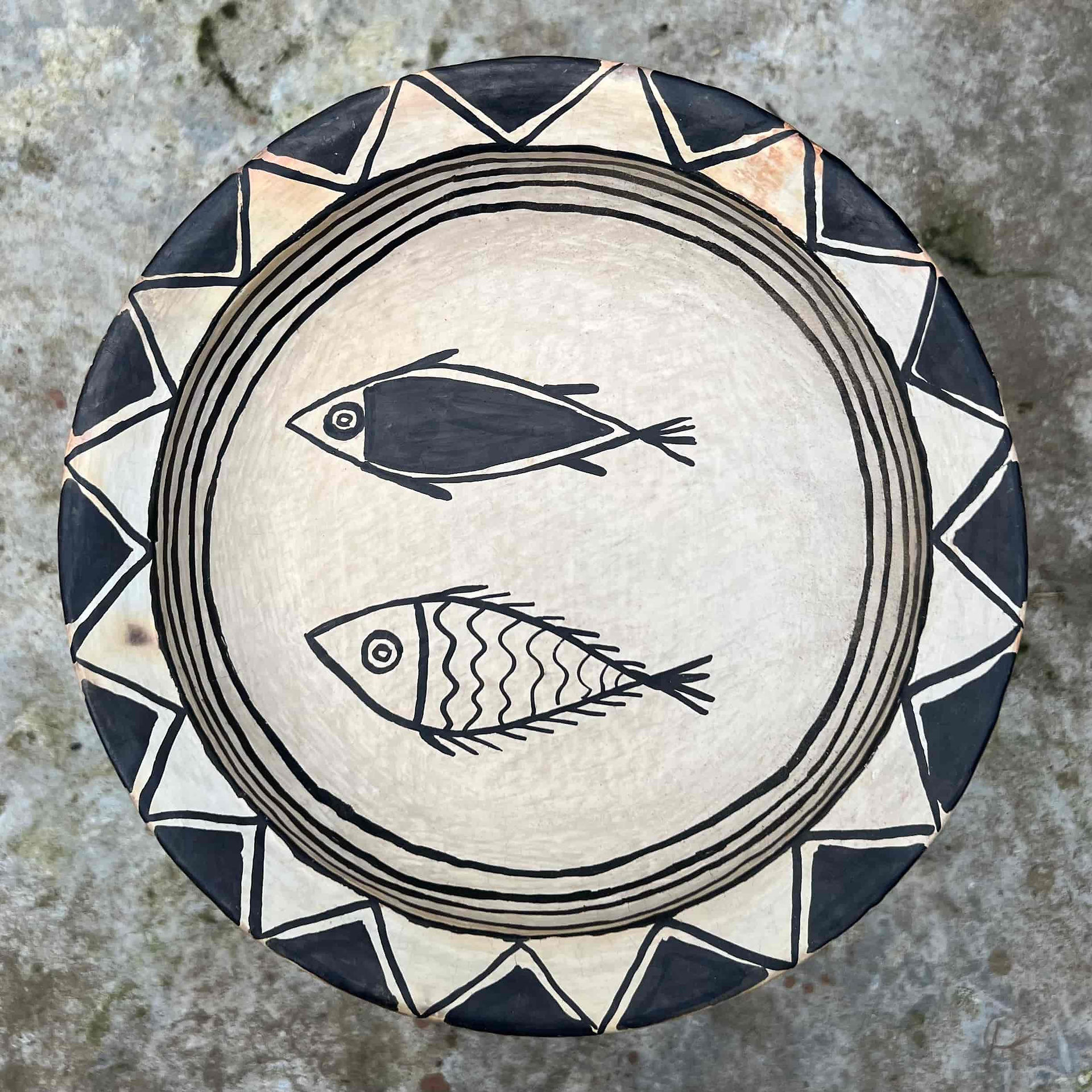
A hand-built bowl requires the maker to control its base, wall, rim, balance, drying, and firing. Its proportions respond to what it is expected to hold and how it will be handled.
Explore functional Sejnane pottery currently documented through My Chakchouka.
Animal and Human Forms


Tortoises, horses, birds, dolls, human figures, and other sculptural objects allow clay to move in different directions.
A figure may be built around an upright cylindrical body. A head can be modelled directly above it. Arms, ears, facial features, clothing, or markings may be added or drawn across the form.
Sculptural work is not disconnected from the domestic pottery tradition. It draws on the same broader understanding of clay, moisture, joining, surface, drying, and fire.
What changes is the object’s direction.
The movement between vessels and figures also shows how a living practice responds to changing use and demand. Makers can continue inherited material knowledge while developing forms suited to new homes, markets, exhibitions, and individual interests.
Individual Makers Within a Shared Tradition


A shared tradition does not eliminate individual authorship.
Sejnane potters work within overlapping knowledge, materials, techniques, and regional conditions. But they do not make identical objects.
Each maker develops her own relationship with proportion, pressure, balance, colour, markings, and form. Some works are extensively decorated. Others depend more strongly on modelling or tonal variation. Human figures may be narrow and upright, broad and rounded, restrained, expressive, painted, or deeply dark.
When a maker’s identity is known, it should remain attached to her work.
My Chakchouka currently documents Hadda Saidani, a potter and sculptor from Sejnane whose practice extends across vessels and individually modelled human figures.
Four sculptures by Hadda show different treatments of the standing body. One is extensively painted, with joined hands, clothing, facial features, jewellery-like details, and geometric markings. Another has an elongated earth-toned form. A third combines a narrow body with a deep black surface. The fourth is broader, with modelled breasts and long curved arms.
These works belong within the wider Sejnane tradition without becoming anonymous examples of it. They are objects made by Hadda and shaped through her own decisions.
Hadda is one documented maker, not a representative for every woman practising pottery in Sejnane. As My Chakchouka’s documentation develops, additional makers and forms may enter the ecosystem without requiring the tradition to be reduced to one person or style.
Continuity and UNESCO Recognition
In 2018, the pottery skills of the women of Sejnane were inscribed on UNESCO’s Representative List of the Intangible Cultural Heritage of Humanity.
The recognised element is not a collection of certified objects. It is a living system of knowledge and skills connected to gathering and preparing clay, shaping and decorating pottery, firing it, transmitting the practice, and sustaining its social role.
The inscription gave international visibility to a practice that already existed.
It did not create Sejnane pottery, establish one official style, or turn every object made in the region into a UNESCO-certified product. Recognition concerns the cultural practice and the communities that carry it.
UNESCO also documents the ability of the women of Sejnane to respond to socioeconomic change and fluctuations in demand. That capacity matters because continuity is not the same as complete technical or visual stillness.
Domestic needs change. Materials and working environments change. Roads, markets, training, exhibitions, tourism, and international interest create new conditions. Makers may produce different proportions of vessels, animals, dolls, or decorative objects in response.
Adaptation does not necessarily sever the relationship with inherited knowledge.
A living practice continues because people keep using, teaching, adjusting, and developing it. Safeguarding therefore cannot mean freezing every object into one historical appearance. It means supporting the conditions through which knowledge can remain active, useful, transmissible, and connected to the women who carry it.
Explore Sejnane Pottery
Follow the Making Process
Follow clay from preparation through shaping, surface treatment, drying, and open firing through Chmissa’s working practice.
Meet a Sejnane Potter
Explore Hadda Saidani’s pottery and sculptural practice, including her individually modelled human figures and documented participation in cultural projects.
Explore Sculptural Forms
Discover four unique, freestanding human figures made by Hadda Saidani, each approximately 30 centimetres high.
Explore Functional Pottery
Explore hand-built bowls, dishes, and vessels connected to the wider Sejnane pottery tradition.
Frequently Asked Questions
What is Sejnane pottery?
Sejnane pottery is a hand-built earthenware practice from northern Tunisia. It uses locally gathered clay and knowledge associated particularly with women potters. Objects are formed without a potter’s wheel and can include domestic vessels, animals, dolls, and human figures.
Where is Sejnane pottery made?
It is made in Sejnane and surrounding communities in the Governorate of Bizerte in northern Tunisia. Clay and other materials used in the practice are commonly gathered from the surrounding landscape, including seasonal wadi beds.
Why is Sejnane pottery made without a wheel?
The practice developed through direct hand-building techniques rather than continuous rotation on a potter’s wheel. Makers form, join, press, model, and refine the clay by hand. This is a complete technical system, not an incomplete version of wheel-thrown pottery.
Who makes Sejnane pottery?
The recognised pottery skills are carried principally by women. Knowledge has often been transmitted through families and communities, including from mothers and grandmothers to younger generations. Individual potters retain their own approaches to form, surface, and decoration.
What materials and colours are used?
Local clay forms the body of the pottery. Documented practices also include clay or earth-derived coatings, plant-derived materials, polishing, markings, and open firing. These relationships can produce cream, ochre, red, brown, grey, and black surfaces. Exact methods vary between makers and objects.
What kinds of objects do Sejnane potters make?
The practice supports bowls, dishes, pots, jars, serving and storage vessels, animals, dolls, human figures, and other decorative or sculptural forms. Makers may adapt what they produce in response to domestic needs, personal direction, exhibitions, and changing demand.
Is all Sejnane pottery safe for food or water?
No universal claim can be made for every object. Suitability depends on the individual piece, its firing, porosity, surface treatment, condition, and intended use. Follow the guidance supplied with the particular product. My Chakchouka’s available tableware has its own use and ceramic care guidance.
What did UNESCO recognise in 2018?
UNESCO inscribed the pottery skills of the women of Sejnane on the Representative List of the Intangible Cultural Heritage of Humanity. The inscription concerns the knowledge, skills, social practices, and transmission associated with the pottery—not certification of individual products.
Where can I buy Sejnane pottery?
Available objects can be explored through My Chakchouka’s Artisan Ceramic Tableware and Sejnane Pottery Sculptures collections. Individual pages identify the maker whenever that information is available and provide product-specific dimensions, use, care, and availability.


