
Chmissa
Sejnane Potter Working Through the Complete Cycle of Clay
Chmissa is a potter based in Sejnane, northern Tunisia.
She gathers and prepares local clay, builds each object by hand, develops its markings and surface, allows it to dry, and fires it outdoors. Her practice extends across the complete making cycle rather than one isolated stage.
Working outside her home and surrounded by the landscape from which her materials and visual references emerge, Chmissa makes both functional vessels and figurative pottery within the wider Sejnane pottery tradition.
About Chmissa


Chmissa is her first name and the name by which she is publicly known.
Her working environment is integrated into her home and its surroundings. Clay, tools, unfinished forms, fuel, vegetation, animals, and family life remain close to one another rather than being separated into a conventional studio.
This proximity is part of how her practice operates.
Objects are shaped outdoors. Materials move through different stages around the home. Pieces dry in the open air before being fired. Her daughter may help when a task becomes physically demanding, while her grandchildren play nearby as she works.
The practice exists within everyday life rather than outside it.
Learning Through Proximity
Chmissa learned pottery by watching her mother.
She does not describe this knowledge as something introduced through a formal course or a fixed sequence of lessons. From a young age, she remained close to the work until making pottery became something she found herself doing naturally.
Observation gradually became participation.
Through repeated contact with clay, Chmissa learned how to recognise suitable material, judge moisture, build a stable form, join sections, prepare a surface, and decide when an object was ready to dry or face the fire.
This way of learning is central to many hand-based practices. Knowledge is not carried only through verbal instructions. It is also encountered through watching, handling, repeating, adjusting, and remaining close to someone who already understands the material.
Today, Chmissa’s daughter sometimes helps with demanding stages, particularly when materials or objects are heavy. Her grandchildren also spend time around her while she works.
Their presence should not automatically be described as formal training. It does, however, continue the everyday proximity through which Chmissa first became familiar with pottery herself.
Working Through the Complete Cycle


Chmissa participates in every principal stage of making her pottery.
The process begins with gathering clay from the surrounding environment. The material must then be broken down, cleaned, soaked, and brought into a condition suitable for shaping.
Preparation cannot be separated from the finished form.
Clay that is too wet may struggle to support its own weight. Clay that becomes too dry may resist joining or crack under pressure. Chmissa has to respond to the material as it changes rather than follow one measurement that works in every condition.
Once prepared, the clay is formed directly by hand without a potter’s wheel.
A bowl or plate develops through pressure, support, gradual raising, and repeated adjustment. The base, walls, rim, width, and depth must remain connected structurally while the clay is still workable.
After shaping, Chmissa develops the surface and markings before allowing the object to dry. She later arranges and fires the pottery outdoors.
From gathering the clay to judging the fire, each stage depends on decisions made through experience.
The wider process can be followed through The Village Where Pottery Is Still Made Without a Wheel.
Working Between Home and Landscape
Chmissa’s practice is closely connected to where she lives.
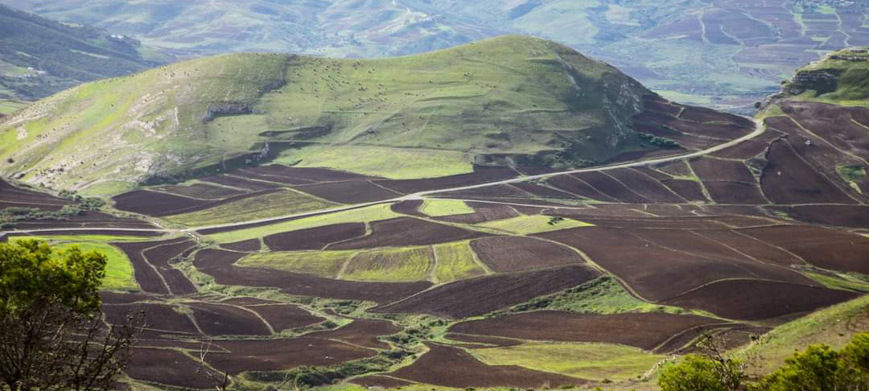
She works outdoors at her home in Sejnane, surrounded by vegetation and the animals and birds that form part of the region’s everyday environment.
The landscape is not simply a background for photographs of her work. It supplies material, space, working conditions, and visual references.
Weather affects how quickly clay dries. Outdoor space allows objects and materials to move between preparation, shaping, drying, and firing. Family members pass through the same environment in which the pottery develops.
This organisation differs from a standard ceramics studio, but it is not an absence of structure. The structure follows the requirements of the material and the spaces available around the home.
Chmissa’s work therefore carries a direct relationship between place and object. The pottery begins within the landscape and is developed through a working system embedded in daily life.
Motifs Drawn From What Surrounds Her


Chmissa does not approach every motif as a calculated design with a predetermined interpretation.
Her visual language emerges from what she has grown up seeing around her.
Birds and other animals from the region appear across her pottery. Lines, triangles, checks, borders, and repeated geometric arrangements develop alongside figurative marks. She also connects parts of this visual vocabulary to forms once seen in Amazigh tattoo traditions.
This does not mean that every line or shape carries one fixed symbolic meaning.
The motifs are better understood as visual references accumulated through familiarity: the landscape, animals, objects, bodies, clothing, markings, and decorative forms that have remained around Chmissa throughout her life.
When these references appear on a vessel, they are filtered through her own hand.
A bird may be extended, simplified, paired, or placed within a geometric border. Fish may occupy the centre of a serving form. Checks, triangles, and lines may follow the structure of a rim or divide the surface into distinct areas.
No two pieces reproduce these decisions with mechanical precision. Small differences in drawing, spacing, form, tone, and firing remain visible from one object to another.
Works by Chmissa
Chmissa’s work includes hand-built tableware made for individual and shared meals.
The current collection contains four principal forms. Each performs a different role at the table while remaining connected through material, hand-building, surface treatment, and visual language.


Within the Sejnane Pottery Tradition
Chmissa’s practice belongs within the shared pottery knowledge associated with the women of Sejnane.
She works with local clay, builds without a potter’s wheel, develops surfaces by hand, and fires her pottery outdoors. She learned through proximity to an older generation and continues to work within an environment where family life and pottery remain close.
These connections place her work within a wider tradition without making it anonymous.
Chmissa is an individual maker. Her proportions, markings, object choices, working rhythm, and responses to the material belong to her own practice.
She should therefore not be presented as a universal representative of every Sejnane potter. Other makers may prepare clay differently, favour other forms, use different markings, or organise their work through different domestic and economic circumstances.
Shared knowledge creates relationships between makers. It does not erase authorship.